267 Views 6 Populality September 2026
Mastercard Foundation Scholars at the University of Rwanda sharpen leadership skills at Nkumba Ubutore Development Centre
Mastercard Foundation Scholars at the University of Rwanda have been challenged to combine knowledge with a spirit of service to become transformative leaders.
The call was made during a week-long Summer Camp at the Nkumba Ubutore Development Centre in Burera District, which took place from 28 August to 5 September 2026.
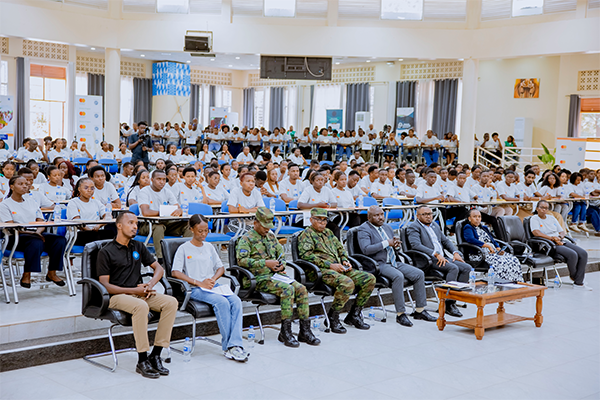
Held under the theme “Raising the Next Generation of Transformational Leaders,” the camp brought together more than 600 Mastercard Foundation Scholars at the University of Rwanda for training, transformative learning, and networking.
The camp was organised to promote personal growth, leadership development, community engagement, physical and mental well-being, creativity, entrepreneurship, and employability, while preparing Mastercard Foundation Scholars to make meaningful contributions to society.
Speaking at the opening session, the Governor of the Northern Province, Mugabowagahunde Maurice, said academic success alone was not enough to prepare young people for leadership.
“We want future leaders to be transformative. A leader is a leader with transformation,” the Governor said.
He urged Mastercard Foundation Scholars to avoid influences that can derail young leaders, citing indiscipline, laziness, and substance abuse.
“You need knowledge, but knowledge alone won’t be enough. You need wisdom and good character as well. Let the knowledge you acquire guide you to become real transformative leaders,” he advised.
Dr. Raymond Ndikumana, Deputy Vice-Chancellor for Strategic Planning and Administration at the University of Rwanda, said leadership is not simply an innate trait but a capability that can be developed.
“Our belief is that leadership is a trainable and learnable skill that can be developed over time,” Ndikumana remarked.
He urged Mastercard Foundation Scholars to embrace discipline, humility, and unity as they develop their leadership abilities.
“Everything that you do must be rooted in unity and discipline. Without discipline, you cannot be a transformative leader. If you want to be one, just be humble. You have a long journey, but you need confidence that goes with discipline and humility.”
A partnership for transformation
The camp is part of a 10-year partnership between the Mastercard Foundation and the University of Rwanda through the Mastercard Foundation Scholars Program.
Associate Professor Anne Marie Kagwesage, Director of the Program at the University of Rwanda, said the initiative aims to support 1,400 academically talented students who face social and economic barriers. So far, 38 Mastercard Foundation Scholars have graduated, while 970 have been enrolled from 13 African countries.
“These students are academically talented and selected to grow into ethical, transformative leaders driving change in Rwanda and across Africa,” Prof. Kagwesage explained. “Leadership is not about titles, it’s about mindset. Giving back is the core of the program.”
She said the camp focuses on building confidence and resilience, leadership development, community service, and networking among Mastercard Foundation Scholars from different campuses.
Ruth Mukakimenyi, Lead of the Mastercard Foundation Scholars Partner Networks, said the partnership is focused on developing young people who can contribute to society now and in the future.
“The Mastercard Foundation Scholars Program is more than a scholarship. It is a journey of transformation,” she added. “At its core, the partnership is built on the shared belief that young people are not merely leaders of tomorrow, but leaders of today,” Mukakimenyi stated.
She identified five pillars of transformational leadership: purpose and vision, service to others, innovation and problem-solving, integrity and accountability, and resilience in the face of challenges.
“Leadership is not something that begins after graduation. It begins now, in how you engage with others during this camp, how you respond to challenges, and how you choose to use your talents and opportunities,” she reminded the Mastercard Foundation Scholars.
Building an elite mindset
Throughout the camp, Mastercard Foundation Scholars participated in sessions designed to strengthen their leadership, personal development, and professional skills.
Topics covered included unity and leadership, entrepreneurship and employability skills, and the role of local government in driving transformational change.
The Mastercard Foundation Scholars also explored mental wellness for academic success, developing an elite mindset, with a focus on discipline, patriotism, and heroism, the culture of investment and saving, and many other topics.
Across the sessions, a number of key messages emerged. Mastercard Foundation Scholars were encouraged to leave a legacy and become role models, recognising that their actions today can influence others and contribute to the future of their communities.
Discipline was repeatedly emphasised as a foundation for success, with a reminder that without discipline, dreams remain mere imaginations. Mastercard Foundation Scholars were also encouraged to practise service before self and to use their time responsibly.
Another key message was the importance of choosing the right networks and avoiding negative peer pressure. Mastercard Foundation Scholars were encouraged to move beyond simply identifying problems in their communities and instead take action to address them.
The Mastercard Foundation Scholars were further reminded that transformation is not a finished process but a continuous responsibility. It was likened to a relay race in which each generation has a role to play in carrying the baton forward.
Mastercard Foundation Scholars commit to leadership and discipline
Samuel Bimenyimana, an Electronics and Telecommunications Engineering student at the University of Rwanda’s College of Science and Technology, said the camp had reinforced the importance of discipline alongside academic knowledge.
“I am learning time management, the importance of waking up early, and discipline. I’ve realised that knowledge is not enough; we need to embrace discipline, positive values, and go beyond self,” Bimenyimana said.
The camp also included community service. On 29 August, Mastercard Foundation Scholars joined residents of Burera to support the construction of a house for a vulnerable resident in Kinoni Sector, Burera District.
Mastercard Foundation Scholars also conducted screenings for non-communicable diseases in the community and held community talks on combating the use of illicit alcohol, particularly among young people.
Hala Waleed Makki, a first-year medical student from Sudan, said the community engagement experience had broadened her understanding of the importance of serving communities.
“Helping the community has been such a wonderful experience. It makes me feel better to help people,” she said.
Speaking at the closing ceremony, the Minister of National Unity and Civic Engagement, Dr. Bizimana Jean Damascene, said building the country begins with individual responsibility, unity, and collective action.
While officially closing the Summer Camp, Associate Professor Kayihura Muganga Didace, Vice Chancellor of the University of Rwanda, urged participants to embrace leadership as a personal responsibility rather than something limited to a particular position or profession.
“Leadership begins with you, regardless of your field or position. Lead through action, learn from others, and always do what is right,” he said.
Prof. Kayihura encouraged the Mastercard Foundation Scholars to demonstrate leadership through their daily actions, remain open to learning from those around them, and uphold integrity and responsible decision-making in their respective fields.
Search
Follow Us
Related contents

Psychosocial Support Services
Access our Online Psychosocial Support for mental health care.
Our Systems